

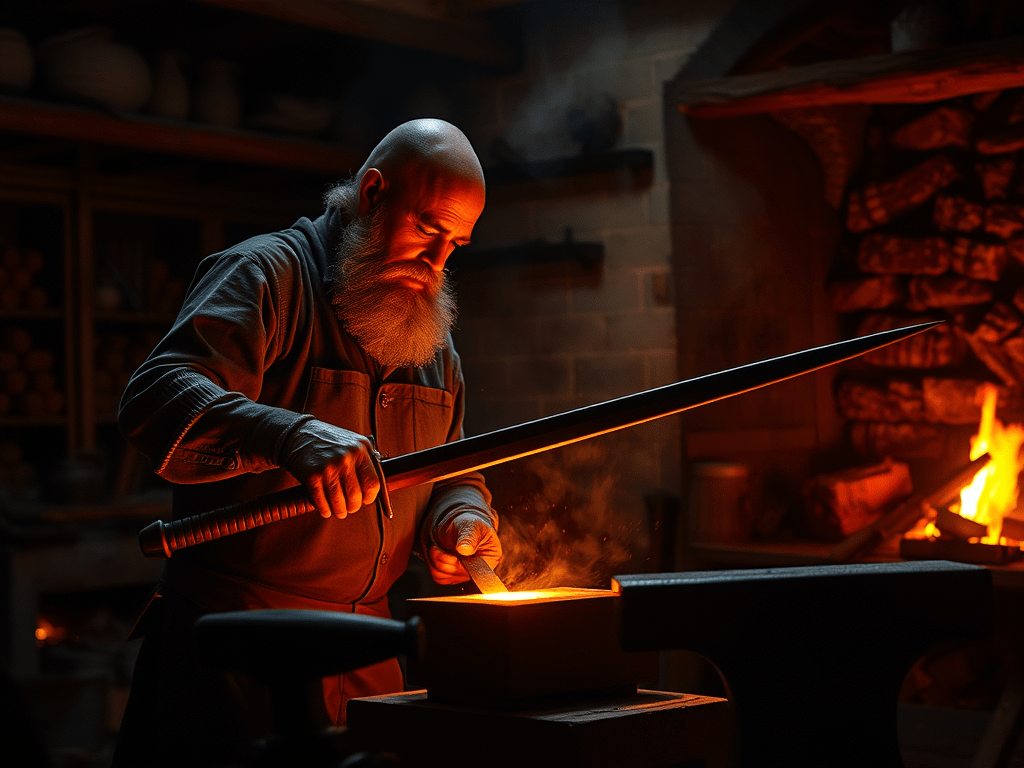
Life is a forge. We begin as unshaped iron—raw, full of potential, but without form. Yet, like a master smith, life takes us through fire, hammer, and anvil, shaping us into something strong, sharp, and purposeful. This process is not unlike the Biblical truth that we are “knit together” in our mother’s womb (Psalm 139:13), crafted with intent and care. But the work doesn’t end there. From birth to our final days, we are continually refined, sharpened, and wielded for a greater purpose.
This is the story of our forging.
The Raw Material: Birth and Potential
We enter the world much like iron ore pulled from the earth—unrefined, but brimming with possibility. There is intent in our creation, a divine spark that sets us apart from mere metal. We are not random; we are purposed. Yet, at this stage, we are formless, without direction or edge. Our potential is vast, but it requires the hands of others to begin the shaping process.
In these early days, we are like the first lump of iron in the forge—hot with life but lacking structure. We cry, we sleep, we grow, but we do not yet know who we are or what we will become. That knowledge rests in the hands of the smiths who will guide us.
The Rough Product: Childhood and the Handle of Upbringing
As we grow, our parents become the first smiths in our lives. They are the ones who take the raw material of our being and begin to give it form. They craft the handle—the foundation of our character, built from the beliefs, morals, values, and faith they instill in us. This handle is what keeps us grounded, preventing us from being wielded wildly in the chaos of life. It is the steady grip that will guide us through every battle to come.
But they do more than just give us a handle; they also begin to shape our edge. Through discipline, love, and teaching, they hammer out the first rough lines of who we will become. We are not yet sharp, but we are no longer formless. We have direction, even if we do not yet understand it.
I remember my own childhood as a time of wonder and correction, of learning right from wrong in the smallest of ways—whether it was being told to share with my siblings or sitting through Sunday school lessons that planted seeds of faith. These were the first taps of the hammer, gentle but formative.
The Shaping: Adolescence and the Anvil of Youth
Then comes adolescence, and with it, the fire. These are the years when life begins to heat up, when we are thrust into the forge of identity, passion, and conflict. Like iron being hammered on the anvil, we are shaped by the trials of youth—friendships, heartbreaks, mistakes, and triumphs. For me, this was a time of raw intensity. I got into quite a few fights in high school, my fists meeting the chaos of those years head-on. More than once, I was kicked out of school, sent away to cool in the aftermath of my rebellion. Yet, each clash, each consequence, was a strike of the hammer, bending me, folding me, forcing me to confront who I was and who I could become. It is a time of intense pressure, where we are reshaped over and over again.
I recall the confusion of those years, the feeling of being pulled in a hundred directions, unsure of where I fit. Yet, looking back, I see that each challenge—the fights, the expulsions, the failures—was a fold in the metal, making me stronger with every blow. We may not appreciate it in the moment, but this is when the blade begins to take form.
It is also in these years that we first taste the heat of the forge—our first real encounters with pain, loss, and responsibility. But as any smith knows, fire is necessary. Without it, the metal remains weak and unyielding.
The Sharpening: Early Adulthood and Life’s Experiences
In my twenties, I felt the weight of sharpening through a life forged in service and exploration. As a soldier in the US Army, I went from the hot and dry ranges of Fort Sill to the humid trails and swamps of Fort Stewart, then to the skies over Germany as an OH-58 Crew Chief. Deployments to Kosovo, Iraq and Kuwait carved resilience into my core. Long hours ensuring aircraft readiness, the pulse of missions abroad, and the bond within my units shaped my discipline and grit. Beyond the military, my travels to over 40 countries—following the Apostle Paul’s path through the ancient streets of Rome, Greece, Macedonia, and Jerusalem and Alexander the Great’s ruins—deepened my soul, teaching me to see the world’s history and my place in it. Later, in my forties, my mission trips to South America—building churches near Manaus, Brazil, a Bible campus in Ecuador, and a church in Honduras—along with serving an orphanage in Guatemala and remodeling a building in Poland for Ukrainian widows and children, ground down my pride, revealing a calling to lift others up. There were moments when setbacks—a botched training drill, a misstep in a foreign land, or the weight of sacrifice—threatened to dull me, but each experience, from battlefield to holy ground, honed my edge, teaching me to cut through life’s chaos with clarity and find my path as a soldier, wanderer, and servant.
The Refinement: Mid-Life and Divine Sharpening
As we enter mid-life, the sharpening takes on a new dimension. This is when God begins to put the final razor’s edge on us. Like a katana being polished to perfection, we are refined through the trials and triumphs of this stage. Our faith is tested, our purpose clarified, and our character honed to its finest point.
For me, this came in my forties, when I faced the loss of loved ones, the weight of raising children, and the realization that life was not infinite. It was a time of spiritual awakening, where I felt God’s hand guiding me through the fire like Shadrach, Meshach, and Abednego , not to break me, but to perfect me. I began to see that every struggle, every moment of doubt, was part of a greater design to make me not just strong, but precise—able to cut through the superficial and strike at the heart of what mattered.
This is also when we begin to understand the true power of our blade. We are no longer just surviving; we are thriving, wielding our strength with intention and grace.
The King Stage: Maturity and Wielding Strength
In the King stage, we reach the height of our forging. We are firm, disciplined, and battle-tested, much like the samurai sword in its prime. This is the time when we wield our strength for the good of others—leading, protecting, and serving with the wisdom we’ve gained.
John Eldredge speaks of this in The Way of the Wild Heart, describing it as the stage where a man steps fully into his purpose. I’ve seen this in my own life, as I’ve mentored younger men, guided my family, and taken on roles that required not just strength, but discernment. It is a time of action, but also of responsibility. The blade is sharp, and it must be wielded with care.
Yet, even in this stage, the handle remains essential. Our upbringing, our faith, our values—they keep us from becoming reckless. We are not a weapon of destruction, but one of protection and justice.
The Sage Stage: Wisdom and the Retired Blade
Finally, we reach the Sage stage, where the blade is retired but far from dull. Like a samurai sword hanging on the wall, we are still sharp, still deadly, but our primary role shifts from action to guidance. We become the old man in the corner, the one others seek for definitive answers.
In this stage, our experiences become our greatest asset. We have endured the forge, the fire, the sharpening stone, and the battles. Now, we offer wisdom to those still in the midst of their forging. I imagine myself here one day, sitting quietly, watching the younger generation wrestle with the same hammers and anvils I once faced, offering a word of encouragement or a hard-earned truth when needed.
It is a stage of stillness, but not of irrelevance. The retired blade is still revered, still capable of cutting to the heart of a matter. It is the final gift of the forging process—the ability to guide others through their own journey.
Embracing the Forge
Life, like the forge, is not always kind. There are times when the heat feels unbearable, when the hammer strikes too hard, when the sharpening seems endless. But in those moments, we must remember that we are being crafted for a purpose. Each trial, each loss, each victory is part of the process that makes us who we are meant to be.
As I reflect on my own journey, I see the hand of the Master Smith in every stage. From the raw iron of my birth to the sharpened blade of my maturity, I have been shaped by forces greater than myself—by family, by friends, by faith, and by the quiet, persistent work of God in my life.
And so, to you, the reader, I say this: embrace the forge. Trust the process. You are being made into something extraordinary, something with purpose and edge. And one day, when your blade is finally laid to rest, you will hang on the wall not as a relic, but as a testament to a life well-forged.
 Hoodlm's Thoughts, Reviews and How-To's