

Mastering the Choice Between Distance and Score
Golf, at its heart, is a game of contrasts. For many amateurs, the allure of the sport lies in the raw power of a well-struck drive—watching the ball soar 300 yards down the fairway, a testament to strength and technique. This is the essence of “brute golf,” where the focus is on smashing the ball as far as possible, often at the expense of precision. On the other hand, “smart golf” prioritizes strategy, course management, and consistency, aiming to lower scores through calculated decisions rather than sheer distance. The tension between these two approaches is a defining challenge for golfers, particularly those new to the game or stuck in a plateau. Many amateurs find it difficult to reconcile the desire to hit it far with the need to shoot a lower score, often swinging between the two without mastering either. This article explores this dichotomy, drawing on personal experiences to illustrate how understanding key concepts—like the difference between “total” and “carry” distances—can bridge the gap and lead to better golf.
The Allure of Brute Golf
For many, golf begins with the driver. The satisfying crack of the club face against the ball, the rush of seeing it disappear into the distance, and the bragging rights that come with a long drive are intoxicating. This is brute golf in its purest form—relying on power, speed, and the occasional miracle shot to dominate the course. As a retired Army guy who picked up golf in 2018, I can attest to this pull. My first drives, clocking in at an average of 270 yards with a personal best of 384 yards, were a source of pride. With a Krank driver setup delivering 288 yards and a secondary driver at 255 yards, I reveled in the ability to outdistance my playing partners. The 3-wood (231 yards) and 7-wood (213 yards) further fueled this mindset, offering a chance to unleash power on par 5s.
Brute golf thrives on the adrenaline of the long ball. Professional golfers like Bryson DeChambeau embody this style, using data-driven techniques and oversized drivers to maximize distance, often exceeding 350 yards off the tee. For amateurs, the dream is similar: to mimic these feats and intimidate opponents with length. However, this approach comes with a trade-off. The focus on distance often sacrifices accuracy, leading to errant shots that land in hazards, roughs, or out-of-bounds. My own early rounds reflected this, with fairway hit rates hovering below 30%, a statistic that haunted me as I chased distance over control.
The psychological draw of brute golf is undeniable. It feeds into a competitive instinct, offering immediate gratification and a sense of dominance. Yet, this style rarely translates to lower scores for the average player. Courses are designed with hazards, doglegs, and narrow fairways that punish reckless power. At Fremont Hills Country Club, where I recently shot an 80, the tight layout and mature hardwoods lining the fairways underscored this lesson. My driver, while capable of impressive distance, often left me scrambling after missing the short grass, turning potential birdies into bogeys.
The Rise of Smart Golf
Smart golf, by contrast, is about playing the percentages. It’s the art of choosing the right club, managing the course, and prioritizing position over power. This approach became a turning point for me after years of frustration with my game. Two recent revelations transformed my strategy: first, selecting clubs based on the hole’s layout rather than defaulting to the driver, and second, understanding the critical distinction between “total” and “carry” distances. These insights, honed over conversations and practice, led to an 8-stroke drop in my score over a couple of weeks, a testament to the power of strategic play.
The first shift came with “smart golf.” Instead of using my driver on every tee box, I limited it to just three holes in a recent round, opting for a 3-wood (231 yards) or 3-hybrid (220 yards) depending on the fairway’s width, bends, and obstacles. This decision was inspired by watching how professionals like Scottie Scheffler navigate courses, prioritizing fairway hits over distance. At Fremont Hills, with its narrow fairways and small, guarded greens, this approach paid off. By setting up sensible shots to the green—often leaving 100-150 yards for a wedge—I reduced the risk of trouble and increased my Greens in Regulation (GIR) from a typical 4-6 to 8 in my last round.
The second revelation was a light bulb moment about distance. I realized that the yardages I’d been using—such as 168 yards for my 7-iron—represented total distance, including roll, rather than carry, which was closer to 155 yards. This misunderstanding had left many approach shots short, especially on firm greens or over hazards. By clubbing up (e.g., using a 6-iron at 179 yards total, ~165 carry) and aiming for the center of the green rather than the pin, I hit more GIRs and became more “surgical” with my shots. This adjustment accounted for shot dispersion—my irons typically spread ±10-15 yards—and turned a weakness into a strength.
Smart golf requires a mental shift. Staying present, focusing on the current shot rather than past mistakes, has been a key lesson since 2018. This mindset, combined with course management tools like the 18 Birdies app, allowed me to plan each hole’s “safe zone”—the widest part of the fairway or green—ensuring consistency. At Fremont Hills, this meant laying up on par 5s like #11 with a 3-wood, setting up a wedge shot that led to an eagle, rather than risking a driver into trouble.
The Amateur Dilemma: Can You Do Both?
For most amateurs, the challenge lies in balancing brute and smart golf. The desire to smash drives conflicts with the need for lower scores, and the two often seem mutually exclusive. My journey reflects this struggle. Early on, my 270-yard average drive was a point of pride, but my handicap hovered around 20, with scores rarely dipping below 90. The brute approach yielded occasional long shots but frequent double bogeys due to missed fairways and poor approaches. It wasn’t until I embraced smart golf that my scores began to fall, dropping to 80 at Fremont Hills with a net 66, a significant improvement for a 12-13 handicap.
This dilemma stems from a lack of understanding about distance metrics. “Total” distance includes roll after the ball lands, influenced by fairway conditions, wind, and slope. “Carry” distance, however, is the yardage the ball travels through the air, critical for clearing hazards or holding greens. My 7-iron, listed at 165 yards total with my Titleist 716 AP2 irons, has a carry of about 150-155 yards, a gap that cost me strokes when I misjudged approaches. Professionals track carry distances meticulously—PGA Tour players often use launch monitors to know their carry to within 5 yards—but amateurs rarely do. Without this knowledge, brute golfers overestimate their reach, leading to short shots or overswings that sacrifice control.
Equipment exacerbates this issue. My Krank drivers (288 and 255 yards) and Titleist 716 AP2 irons (193 yards for 5-iron down to 144 for 9-iron) are designed for distance and forgiveness, tempting a power-focused game. Yet, the Vokey wedges (52° at 110 yards, 56° at 87 yards, 60° at 68 yards) demand precision, aligning with smart golf. The tension between these tools mirrors the internal conflict: do I unleash the driver or finesse with a wedge? Most amateurs can’t do both effectively because power requires a different swing plane and mindset than accuracy, and switching between them mid-round disrupts rhythm.
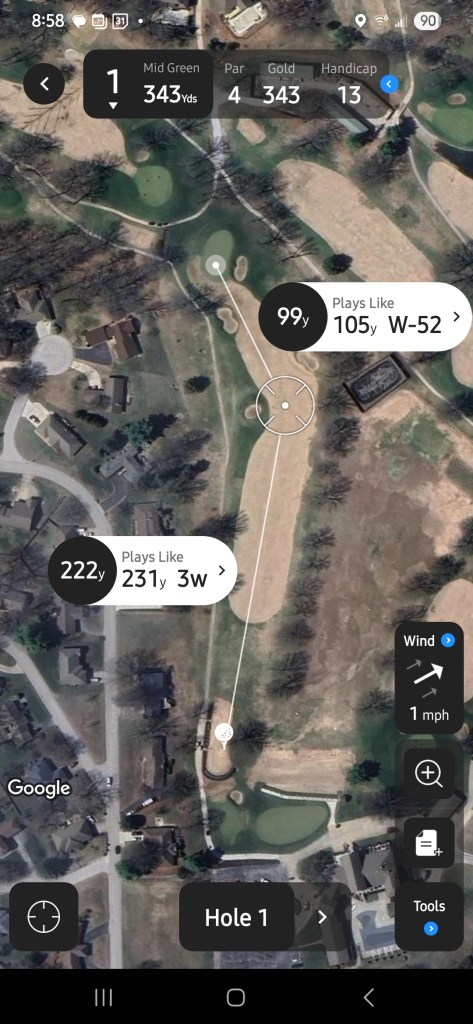
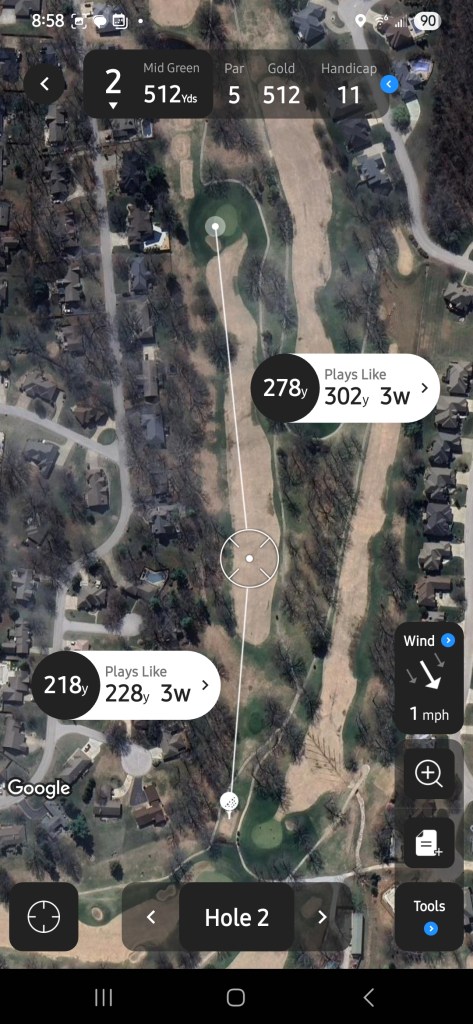
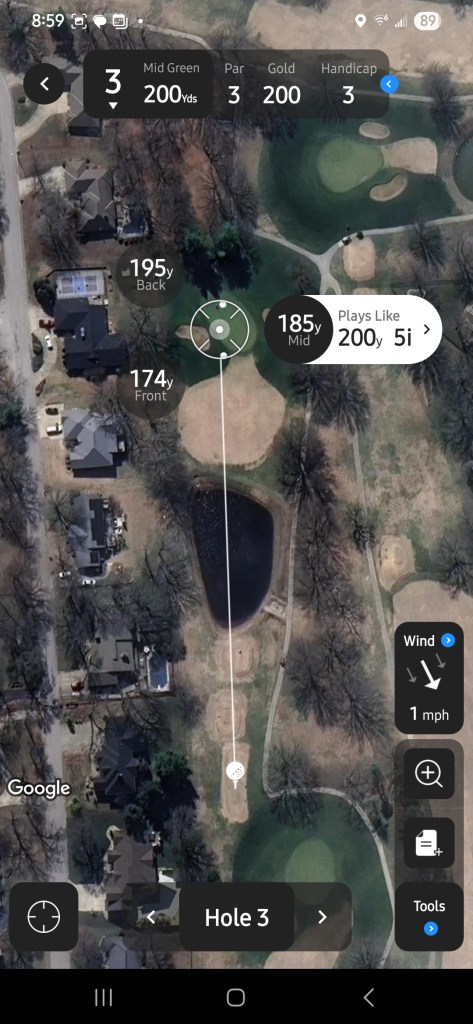
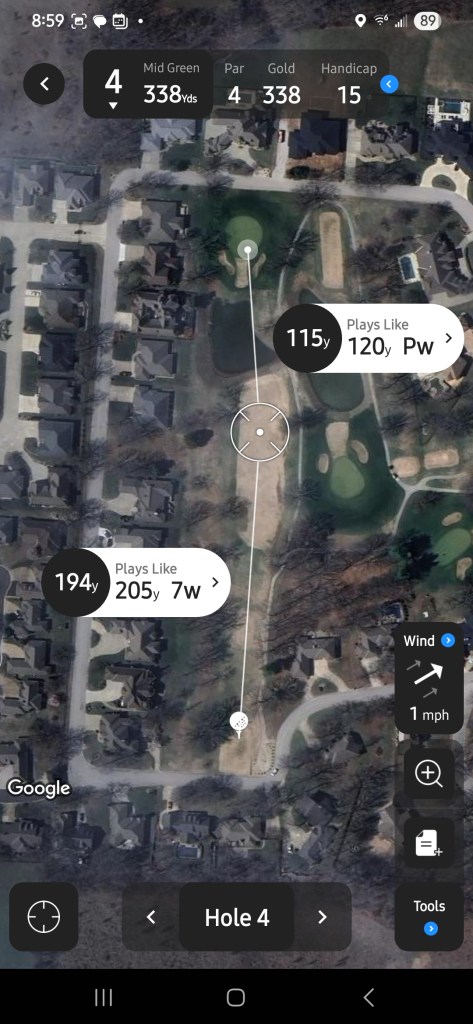
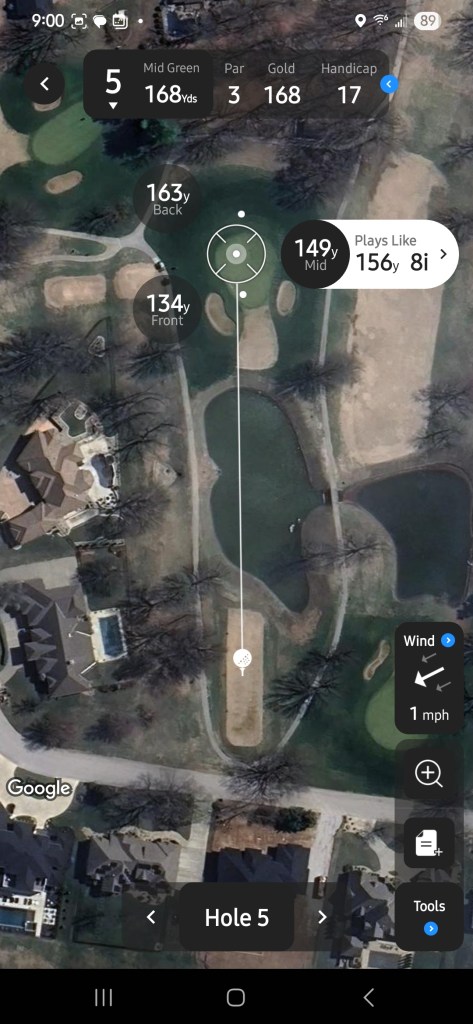
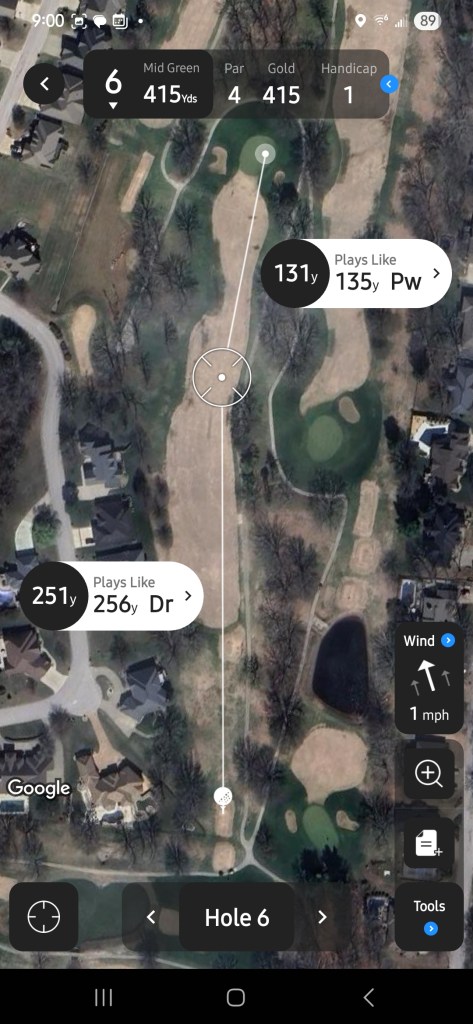
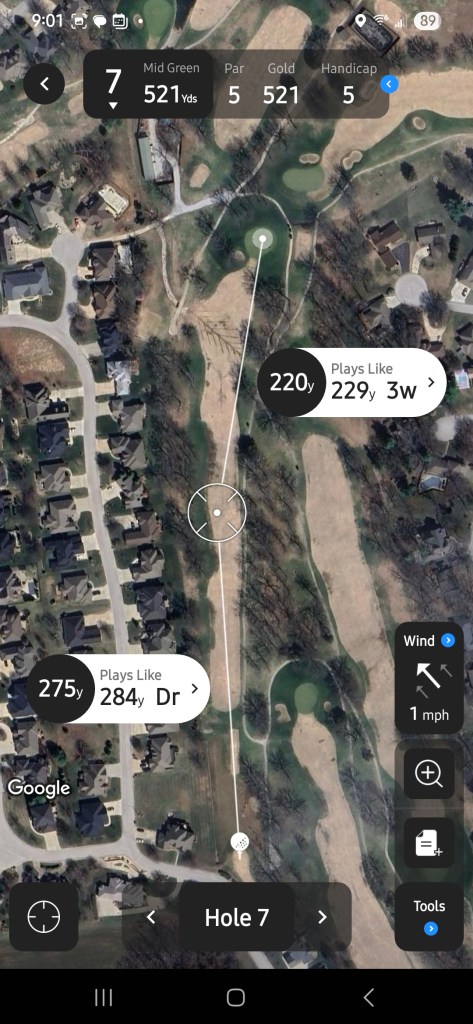
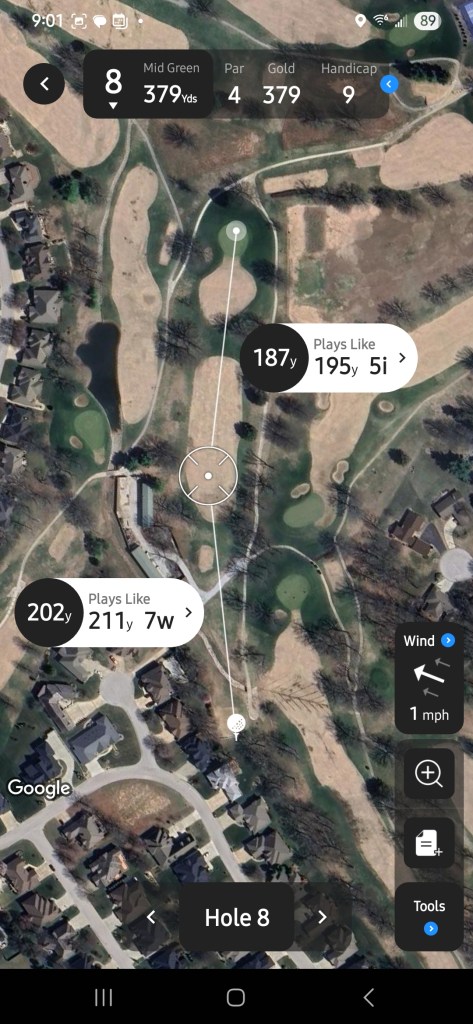
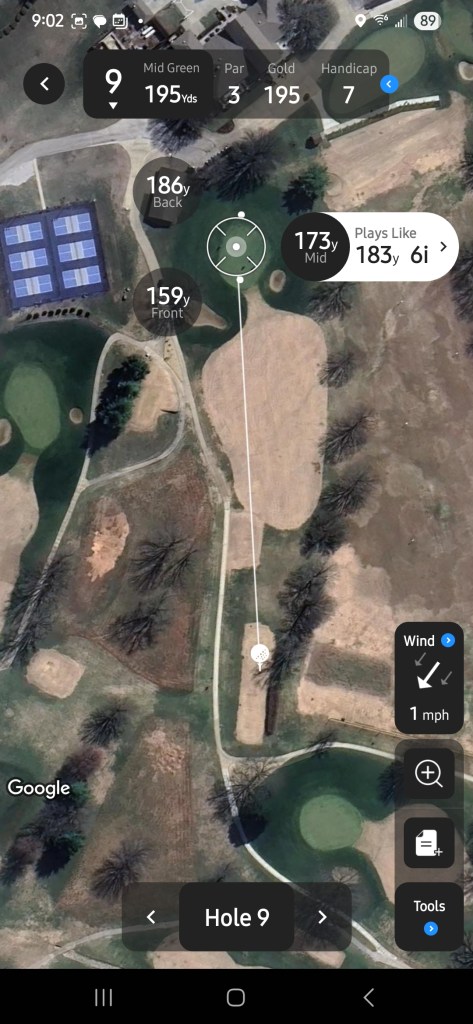
What’s the Play on these holes?
These screenshots are from my 18 Birdies app. This is the front 9. Do you stretch the legs and go for it or do you play chess and dial it back for precision? Considering fairway widths, environmental factors and danger areas, how do you work these holes?
Personal Experiences at Fremont Hills
My recent round at Fremont Hills Country Club, a par-71, 6,023-yard course in Fremont Hills, Missouri, crystallized this choice. The scorecard from July 9, 2025, showed an 80 (41 out, 39 in), with 4 fairways hit, 8 GIR, 17 putts, and 5 chip shots. Highlights included a birdie on the 165-yard par-3 #3 and an eagle on the par-5 #11, balanced by bogeys on the narrow par-4 #17. This round was a microcosm of the brute vs. smart debate.
On #11, a missed fairway with the driver was salvaged by a smart 3-wood layup, setting up a wedge shot that led to the eagle. This showcased how strategic play can turn power into points. Conversely, #17’s bogey stemmed from a driver miss into the trees, forcing a chip and one-putt recovery. The tight fairway demanded a hybrid (220 yards), but my brute instinct overruled, costing a stroke. The 8 GIRs reflected my new approach—clubbing up for carry on approaches with my Titleist 716 AP2 irons—but the 4/14 fairway rate highlighted lingering brute tendencies.
The course’s design, with Bermuda fairways, bent grass greens, and homes lining holes, punishes errant shots. My 56° wedge, which digs on uphill chips, further underscored the need for smart adjustments—perhaps a higher-bounce SM9 option. Knowing my carry distances (e.g., 155 yards for 7-iron vs. 165 total) allowed me to clear front bunkers, boosting GIR. Yet, the temptation to smash lingered, a reminder that brute golf is hard to shake.
The Science Behind Distance
Understanding “total” vs. “carry” distances is foundational to resolving this conflict. Total distance is the end result of a shot, including roll, which can vary widely—10-20 yards on firm fairways or downhill slopes. Carry distance, measured by launch monitors like Trackman, is the air travel, unaffected by ground conditions. For my 7-iron with the Titleist 716 AP2, the 10-yard gap between 165 total and 155 carry was a revelation, explaining why approaches often fell short on Fremont Hills’ firm greens.
This distinction is critical because amateur swings produce inconsistent spin and launch angles, affecting roll. My 270-yard drive, for instance, might carry 250 yards but roll 20 more on a dry fairway, while a wet surface could limit roll to 5 yards. Without knowing carry, I’d misclub, either leaving shots short or overshooting into trouble. Pros use this data to select clubs—e.g., a 7-iron for 160 yards of carry over a hazard—while amateurs guess, often paying the price.
To master this, I’ve started pacing carry distances at the range, confirming my 6-iron at ~165 yards and 5-iron at ~180 yards. This practice, paired with the 18 Birdies app, lets me adjust for wind or elevation, a skill that turned #3’s birdie into a confidence booster. Amateurs can adopt this by testing clubs over 50-yard increments, noting where the ball lands before rolling, and building a carry chart.
Building a Hybrid Approach
The goal isn’t to abandon brute golf but to integrate it with smart play. This hybrid approach leverages power where it’s safe and strategy where it’s needed. My club setup—Krank drivers for distance, Titleist 716 AP2 irons for control, and Vokey wedges for precision—supports this balance. Here’s how to make it work:
Tee Shots
Limit driver use to wide-open holes. At Fremont Hills, I’d reserve the 288-yard driver for par 5s like #11 if the fairway widens, using 3-wood (231 yards) or 3-hybrid (220 yards) on tight par 4s like #17. This preserves distance while hitting more fairways, a key to lowering scores—PGA Tour stats show fairway hits correlate with scores under 70.
Approaches
Focus on carry for GIR. On a 160-yard par 3, my 6-iron (179 total, ~165 carry) with the Titleist 716 AP2 beats the 7-iron (165 total, ~155 carry), ensuring I clear hazards. Aiming for the green’s center accounts for dispersion (±10-15 yards), a tactic that boosted my 8/18 GIR.
Short Game
Refine wedges for recovery. My 56° digs on uphill chips, so testing an SM9 56.12D (higher bounce) could save strokes. Practicing flat chipping zones, as on #17’s recovery, minimizes putts.
Mental Game
Stay present. After a missed drive, focusing on the next shot—e.g., a hybrid layup—prevented blow-ups, a lesson from years of play.
Lessons from the Pros
Pros offer blueprints. Fred Couples’ relaxed swing maximizes power with fluidity, while Justin Rose’s mechanical style ensures repeatability. Rory McIlroy blends tension and ease, using a straight left arm for leverage but a smooth tempo for consistency. Bryson DeChambeau’s data-driven power contrasts with Scottie Scheffler’s strategic precision. Amateurs can adapt these: use Couples’ tempo for drives, Rose’s control for irons, and Scheffler’s planning for course management.
The Path Forward
My 80 at Fremont Hills, with its eagle and birdie, shows smart golf’s potential, but the 4 fairway hits remind me brute habits die hard. Tracking carry distances, refining wedge play, and planning each hole’s safe zone are next steps. For amateurs, the choice isn’t brute or smart—it’s both, applied wisely. By mastering carry vs. total distances and balancing power with precision, the dream of lower scores becomes achievable, turning the golf course into a playground of strategy rather than a battleground of might.
This journey, from 90s to 80s, proves that golf rewards the mind as much as the muscle. Whether it’s a 384-yard drive or a 155-yard carry to a green, the real victory lies in knowing when to smash and when to strategize. For every golfer chasing that elusive score, the lesson is clear: smart golf wins, but a touch of brute flair keeps it fun.
 Hoodlm's Thoughts, Reviews and How-To's