

Abstract
This article investigates FM 30-31B, a disputed 1970 U.S. Army Field Manual supplement, as a potential blueprint for a transnational “deep state” to orchestrate crises and foster citizen dependence. Drawing from an extensive dialogue, we examine whether post-World War II events—Operation Ajax, Al Qaeda’s 9/11 attacks and the Iraq War, U.S. school shootings, George Floyd protests, COVID-19, and the January 6, 2021, Capitol riot (“J6”)—were manipulated using FM 30-31B’s tactics of infiltration, provocation, and perception management, with the Soviet Union framed as a scapegoat. The manual’s origins are tied to the U.S. Army Special Forces, founded by Colonel Aaron Bank, and the CIA, established by Bill Donovan, both rooted in WWII OSS operations. FM 30-31B is analyzed as a “recipe” to create enemies (e.g., Osama bin Laden, Saddam Hussein) to justify U.S. actions, exemplified by the Iraq War and the killing of bin Laden by Navy SEAL Rob O’Neill. J6 is scrutinized as a possible “deep state” operation to discredit Donald Trump, with claims of FBI informants inciting violence and “right-wing patriots” facing alleged illegal imprisonment. Legislative measures like the USA Patriot Act and Red Flag laws serve as examples of control mechanisms. While FM 30-31B’s tactics align with these events, its likely Soviet forgery, lack of evidence, and organic event roots suggest opportunism, systemic flaws, and disinformation over a singular plot. The article concludes with reflections on obscured truth and future research.
Introduction
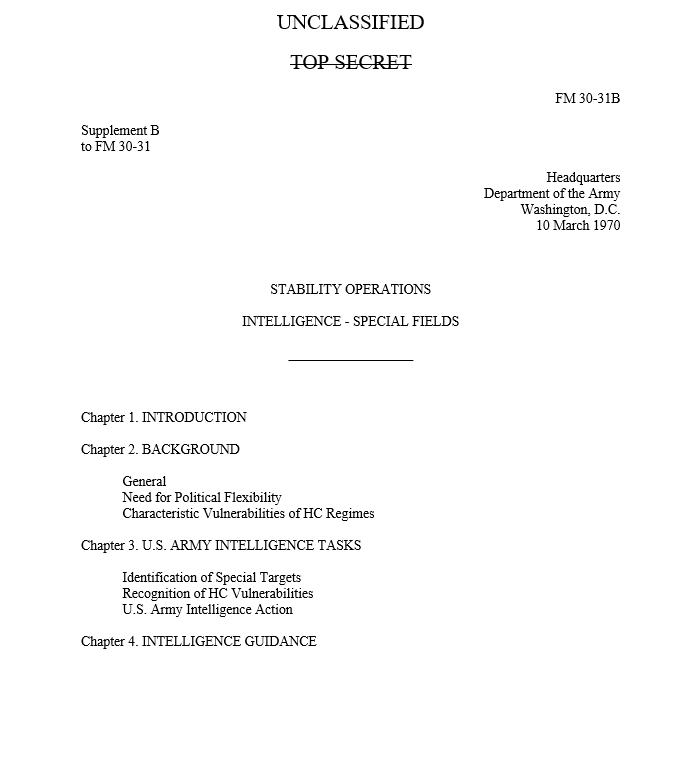
FM 30-31B, titled “Stability Operations – Intelligence – Special Fields,” surfaced in the 1970s as a purported U.S. Army supplement advocating clandestine tactics to manipulate host country (HC) agencies and insurgents. Its provocative Section 11 (FM 30-31B, Page 9) instructs intelligence to infiltrate insurgencies, forming “special action groups” to provoke actions justifying counterinsurgency. Deemed a Soviet forgery by the U.S. State Department (2006), its authenticity is contested due to alignment with covert operations like Operation Gladio. The manual’s inception reflects the U.S. military’s post-World War II focus on unconventional warfare and intelligence, driven by the U.S. Army Special Forces, founded by Colonel Aaron Bank in 1952 to conduct guerrilla warfare and counterinsurgency, and the Central Intelligence Agency (CIA), established in 1947 under William “Bill” Donovan’s influence to coordinate global intelligence and covert action. Both Bank and Donovan were veterans of the Office of Strategic Services (OSS) during WWII, with Bank serving in Jedburgh Teams supporting resistance movements and Donovan leading the OSS’s espionage and sabotage efforts.
The U.S. Army employs Field Manuals (FMs) to codify tactics, with Special Forces specializing in Foreign Internal Defense (FID), which includes disinformation and misinformation campaigns to destabilize enemy governments by turning citizens or groups against ruling parties. Special Forces train guerrilla forces to create fighting units, often using psychological operations to sow distrust. In contrast, the CIA operates covertly, akin to the French Resistance, engaging in espionage, subterfuge, counterinsurgency, and psychological operations to recruit agents within target nations, gathering intelligence to undermine adversaries. FM 30-31B, whether authored by the U.S. or Soviets, encapsulates these strategies, serving as a “perfect recipe” to “create” enemies—such as Osama bin Laden or Saddam Hussein—to rally public support for U.S. actions. This manipulation, the hypothesis suggests, fosters dependence on a corrupt government, turning citizens into “subjects and slaves” through fear and control mechanisms like the USA Patriot Act (2001), which expanded surveillance post-9/11, and Red Flag laws, which restrict firearm access after school shootings.
This article stems from a dialogue hypothesizing that FM 30-31B is a blueprint for a global “deep state”—a coalition of intelligence agencies, corporations, and political insiders—to orchestrate crises and create enemies, framing the Soviets to enable covert use. Events analyzed include Operation Ajax, 9/11 and the Iraq War (with bin Laden’s killing by Rob O’Neill and Saddam’s scapegoating), school shootings, George Floyd protests, COVID-19, and J6, where FBI informants allegedly incited violence to target Trump and imprison “right-wing patriots.” This article assesses feasibility, evidence, alternatives, and outcomes, focusing on FM 30-31B’s strategies and the “deep state” narrative.
FM 30-31B: Content and Strategic Context
FM 30-31B, dated March 10, 1970, is a TOP SECRET supplement to FM 30-31, focusing on intelligence support for U.S. Army stability operations in HC nations. It targets HC agencies (armed forces, police, civilian bodies), advocating covert operations to advance U.S. interests (FM 30-31B, Page 2). Key sections include:
- Chapter 2: Background (Pages 3–4): Notes U.S. flexibility in supporting HC regimes based on anti-communist alignment, highlighting vulnerabilities like instability and corruption.
- Chapter 3: U.S. Army Intelligence Tasks (Pages 5–7): Directs monitoring of HC armies and police, promoting loyal officers.
- Chapter 4: Intelligence Guidance (Pages 7–10): Advocates recruiting HC officers as agents (Page 8) and infiltrating insurgencies to provoke actions (Page 9, Section 11):
“U.S. Army intelligence should seek to penetrate the insurgency by means of agents on special assignment, with the task of forming special action groups among the more radical elements of the insurgency… to launch violent or non-violent actions according to the nature of the case.”
- Secrecy: Limited distribution and verbal instructions (Page 3) ensure deniability.
The U.S. labels FM 30-31B a Soviet forgery, citing its absence from Army catalogs and dissemination via communist-leaning outlets (e.g., Barış, 1973) in Turkey, Spain, and Italy. Scholars link it to Soviet disinformation (e.g., Operation INFEKTION), but its resonance with U.S. operations (Gladio, COINTELPRO) fuels debate.
Strategic Context: FM 30-31B’s tactics align with the complementary roles of Special Forces and the CIA. Special Forces’ FID missions involve training guerrillas to destabilize enemy regimes, using disinformation to fracture ruling parties, as seen in Vietnam’s Civilian Irregular Defense Group. The CIA, operating covertly, recruits agents to gather intelligence and sow dissent, as in the 1953 Iran coup. The manual codifies these strategies, providing a framework to infiltrate, provoke, and manipulate public perception to justify U.S. interventions. Whether U.S.- or Soviet-authored, FM 30-31B is a “perfect recipe” to create enemies, rallying public support for wars or control measures while masking elite agendas. By framing figures like bin Laden or Saddam as threats, the U.S. government could foster dependence, aligning with the “deep state” hypothesis of turning citizens into compliant subjects.
The “Deep State” Hypothesis
The “deep state” is a transnational coalition of elites—intelligence agencies (CIA, MI6), corporations, and political insiders—manipulating events for power, profit, or control, potentially via NATO or Bilderberg Group coordination. The hypothesis posits this “deep state” authored FM 30-31B to guide crises, blaming the Soviets to deflect scrutiny, aligning with Cold War disinformation tactics.
Feasibility
- Authorship: A “deep state” could leverage military and intelligence expertise to craft FM 30-31B, leaking it via proxies to frame the Soviets, as seen in KGB forgeries.
- Motive: The manual’s tactics enable crises (coups, riots, terrorism) justifying control, benefiting elites through profits (defense, pharma) and power.
- Secrecy: Limited distribution (Page 3) ensures insider use, while leaks sow distrust, weakening resistance.
Challenges
- Evidence: No documents confirm “deep state” authorship. Soviet dissemination supports forgery.
- Coordination: A decades-long global plot requires unprecedented secrecy, unlike smaller conspiracies (e.g., Iran-Contra, 1986).
- Disinformation: If Soviet, FM 30-31B provokes suspicion, trapping the hypothesis in its narrative.
Post-WWII Events: Orchestrated or Opportunistic?
We analyze events to assess whether FM 30-31B’s tactics—infiltration, provocation, perception management—were used by a “deep state” to foster dependence, focusing on crisis creation and created enemies, with J6’s alleged FBI provocation and patriot persecution, and bin Laden and Saddam as scapegoats.
1. Cold War Covert Operations (1945–1991)
Events: Operation Ajax (1953 Iran coup), Bay of Pigs (1961), Gladio (NATO stay-behind networks), COINTELPRO (1956–1971).
- Feasibility: FM 30-31B’s tactics align:
- Infiltration: Ajax recruited Iranian agents (Page 8); Gladio trained anti-communist operatives.
- Provocation: COINTELPRO provoked conflict within civil rights groups (Page 9).
- Perception Management: Ajax’s anti-Mossadegh propaganda shaped opinions (Page 7).
- Evidence: Declassified documents confirm U.S./NATO orchestration, with corporate ties (e.g., BP in Iran).
- Deep State Fit: Transnational coordination suggests a “deep state” leveraging FM 30-31B’s tactics.
- Outcomes: Interventions fostered reliance on U.S. security.
- Alternatives: U.S. anti-communist goals explain operations.
- Verdict: Strong FM 30-31B alignment supports “deep state” orchestration, though U.S.-driven.
2. Al Qaeda, 9/11, and the Iraq War (2001–2011)
Context: Al Qaeda, born from U.S.-backed mujahideen (Operation Cyclone, 1979–1989), executed the 9/11 attacks, killing 2,977. The U.S. responded with the $8 trillion War on Terror, including the Iraq War (2003–2011), framing Saddam Hussein as a “bad guy” despite Al Qaeda’s responsibility. Navy SEAL Rob O’Neill claimed to have killed Osama bin Laden in 2011, cementing bin Laden’s role as a created enemy.
- Feasibility: FM 30-31B’s tactics apply:
- Infiltration: Section 11’s “special action groups” (Page 9) could involve manipulating Al Qaeda, with speculation bin Laden was a CIA asset. For Iraq, infiltrating anti-Saddam groups (e.g., Iraqi National Congress) aligns with Page 8.
- Provocation: 9/11 as a staged crisis; Iraq’s invasion as a response to fabricated threats (WMDs), per Page 9.
- Perception Management: Media amplified terrorism fears and portrayed Saddam as a threat (Page 7), enabling war.
- Bin Laden and Rob O’Neill: Bin Laden, Al Qaeda’s leader, was killed in 2011 by Navy SEAL Rob O’Neill during Operation Neptune Spear in Abbottabad, Pakistan. O’Neill’s account, publicized in his book The Operator (2017), framed bin Laden as the ultimate “bad guy,” rallying public support for the War on Terror. FM 30-31B’s perception management (Page 7) aligns with this narrative, creating an enemy to justify prolonged conflict, though no evidence suggests bin Laden was a U.S.-controlled asset post-1980s.
- Saddam Hussein as the “Bad Guy”:
- Role: Saddam, Iraq’s dictator (1979–2003), was a U.S. ally during the Iran-Iraq War, receiving support against Iran. After invading Kuwait (1990), he became a pariah. Post-9/11, the Bush administration falsely linked him to Al Qaeda and WMDs, despite no evidence.
- Why Iraq?: The U.S. invaded in 2003, citing WMDs and terrorism ties. The 2004 Iraq Survey Group found no operational WMDs or Al Qaeda links. Motives included:
- Geopolitical Control: Iraq’s oil reserves (4th largest) and strategic location.
- Perception Management: Saddam’s history (e.g., 1988 Kurdish genocide) made him an easy scapegoat. Polls (2003) showed 70% of Americans believed Saddam was linked to 9/11, driven by media and administration claims (e.g., Cheney).
- Profits: The $2 trillion war enriched contractors like Halliburton ($39 billion).
- FM 30-31B Fit: Framing Saddam aligns with Page 7’s narrative manipulation, creating an enemy to justify intervention.
- Evidence: No proof of CIA control over bin Laden or 9/11 staging. Al Qaeda’s attacks (e.g., USS Cole, 2000) suggest autonomy. Iraq’s WMD claims were debunked; the 2002 National Intelligence Estimate relied on faulty sources (e.g., “Curveball”). X posts allege 9/11 and Iraq were “deep state” plots, but lack sources.
- Deep State Fit: A “deep state” could profit from wars and regional dominance, using FM 30-31B’s tactics to frame bin Laden and Saddam as enemies, fostering dependence.
- Outcomes: Wars and fear created reliance, but insurgency (e.g., ISIS) suggests unintended escalation.
- Alternatives: Blowback from mujahideen support explains 9/11; Iraq stemmed from flawed intelligence and opportunism.
- Verdict: FM 30-31B’s tactics make orchestration plausible, but blowback and opportunism are more evidenced.
3. School Shootings (1999–2025)
Context: Over 420 shootings since Columbine, exposing 390,000+ students. Shooters are suicidal (92% K-12), in crisis (80%), and motivated by bullying (75%) or revenge (61%).
- Feasibility: FM 30-31B’s tactics align:
- Infiltration: Manipulating vulnerable shooters as “pawns” (Page 9) via online radicalization.
- Provocation: Shootings as staged crises to justify control.
- Perception Management: Media’s “deranged shooter” narrative (Page 7) diverts from systemic issues.
- Evidence: No documents confirm FBI/CIA orchestration. X posts alleging MKUltra lack proof. FBI’s inaction on tips (e.g., Parkland) suggests negligence; social factors (120 guns per 100 people, bullying) dominate.
- Deep State Fit: A “deep state” could profit from school security ($3 billion market), using FM 30-31B’s tactics.
- Outcomes: Fear (71% stressed) and drills (39% anxiety) foster reliance, but distrust resists.
- Alternatives: Firearm access and mental health gaps explain shootings organically.
- Verdict: FM 30-31B’s tactics support a “deep state” possibility, but social factors are more evidenced.
4. George Floyd Protests (2020)
Context: Sparked by Floyd’s murder, with 15–26 million participants, 93–96.3% peaceful but $1–2 billion in damages.
- Feasibility: FM 30-31B’s tactics apply:
- Infiltration: Provoking violence via “agent provocateurs” (Page 9).
- Perception Management: Framing protests as “riots” (Page 7) enabled control.
- Evidence: No proof of staging Floyd’s death. Systemic racism (Black wealth 10% of white) drove protests.
- Deep State Fit: A “deep state” could amplify unrest, using FM 30-31B’s tactics.
- Outcomes: Polarization fosters reliance, but BLM’s empowerment resists.
- Alternatives: Historical police violence explains protests organically.
- Verdict: FM 30-31B’s tactics are feasible, but organic roots outweigh orchestration.
5. COVID-19 (2019–2025)
Context: 700 million cases, 7 million deaths, with U.S. lockdowns and mandates.
- Feasibility: FM 30-31B’s tactics align:
- Provocation: A staged pandemic (Page 9) to justify control.
- Perception Management: Fear-driven mandates (Page 7) enabled restrictions.
- Evidence: No proof of U.S. engineering. Natural origin (zoonotic spillover) is likely.
- Deep State Fit: A “deep state” could profit (Pfizer’s $100 billion), using FM 30-31B’s tactics.
- Outcomes: Lockdowns foster reliance, but distrust (CDC’s 43% approval) resists.
- Alternatives: Mismanagement and natural origins explain the crisis.
- Verdict: Opportunistic control outweighs orchestration.
6. January 6, 2021, Capitol Riot (“J6”)
Context: On January 6, 2021, thousands of Trump supporters, rallied by his “Stop the Steal” speech, stormed the Capitol, causing five deaths, 140 police assaults, and $2.7 million in damages. Over 1,572 individuals were charged, with 700+ pleading guilty and 750 sentenced.
- Feasibility: FM 30-31B’s tactics align with claims of a “deep state” targeting Trump:
- Infiltration: Section 11’s “special action groups” (Page 9) could involve FBI informants inciting violence. A 2024 DOJ report confirms 26 FBI confidential human sources (CHS) in D.C., with four entering the Capitol unauthorized.
- Provocation: J6 as a staged crisis to discredit Trump, with X posts alleging a “fedsurrection” via informants like Ray Epps (charged with trespassing, denies FBI ties).
- Perception Management: Media framed J6 as an “insurrection” (Page 7), amplifying control measures.
- FBI Informants and Provocation Claims:
- Evidence: No undercover FBI agents; 26 CHS monitored suspects. Four entered the Capitol, one testifying at the Proud Boys trial. None were prosecuted for trespassing, per policy. DOJ and Wray debunk incitement claims.
- Conspiracy Theories: X posts and lawmakers (e.g., Greene) claim FBI orchestration, citing CHS and Epps. No evidence supports this; Trump’s rhetoric (“fight like hell”) and extremist planning drove the riot.
- Counterpoint: FBI’s intelligence failures suggest negligence, not a plot.
- Arrests and “Illegal Imprisonment” Claims:
- Context: Charges include Proud Boys’ Tarrio (22 years, seditious conspiracy) and Chansley (41 months, released). Trump calls them “hostages,” promising pardons.
- Allegations: X posts claim “illegal imprisonment” without due process. Authorities confirm standard treatment; charges are supported by video and 200,000+ FBI tips.
- Evidence: No “illegal imprisonment”; judges upheld detentions for violent offenders. Over 900 guilty pleas reflect due process. Lengthy detentions (15 held in 2024) raise concerns, but rulings cite safety.
- Deep State Fit: J6 could neutralize Trump, with informants and lax security (e.g., National Guard delays) fueling suspicions. Control measures align with FM 30-31B’s tactics, but DOJ confirms no incitement.
- Outcomes: Fear of “insurrection” fosters reliance, but Trump’s base (34% believe FBI instigated J6) resists. Trump’s 2024 re-election limits control.
- Alternatives: Spontaneous riot fueled by Trump’s rhetoric and extremists, with opportunistic control.
- Verdict: FM 30-31B’s tactics make a “deep state” plot plausible, but lack of evidence and rioter autonomy favor opportunism. Arrests are legal, though detentions raise concerns.
7. Other Events (“Woke,” LGBTQ+, Gaza, Ukraine)
- Context: “Woke” and LGBTQ+ movements grew from activism (Stonewall, 1969). Gaza intensified post-2023 (40,000 deaths). Ukraine followed Russia’s 2022 invasion ($75 billion U.S. aid).
- Feasibility: FM 30-31B’s division (Page 6) and provocation (Page 9) could amplify tensions.
- Evidence: No orchestration proof. Historical roots (racism, occupation, NATO expansion) dominate.
- Deep State Fit: A “deep state” could profit from wars and polarization, using FM 30-31B’s tactics.
- Outcomes: Polarization fosters reliance, but empowerment (LGBTQ+ rights) resists.
- Alternatives: Cultural and geopolitical dynamics explain events.
- Verdict: Organic roots outweigh manipulation, with opportunistic control.
Synthesis: Orchestrated Crises or Opportunistic Control?
Supporting the Hypothesis:
- FM 30-31B’s Blueprint: Its tactics—infiltration, provocation, perception management—fit events from Ajax to J6, codifying Special Forces and CIA strategies to create enemies (Page 9).
- Deep State Plausibility: Elite interests benefit from wars ($8 trillion War on Terror), security ($3 billion school market), and polarization (J6). Historical abuses (MKUltra, COINTELPRO) show manipulation willingness.
- Created Enemies: Framing bin Laden (killed by O’Neill) and Saddam as threats aligns with FM 30-31B’s perception management (Page 7), enabling wars for profit and control.
- Soviet Scapegoat: Framing Soviets aligns with Cold War disinformation, hiding “deep state” authorship.
- J6 Specifics: FBI informants and patriot arrests suggest a “deep state” targeting Trump.
- Dependence Outcomes: Fear, profits, and polarization align with the “subjects and slaves” narrative.
Challenges:
- Lack of Evidence: No documents confirm “deep state” authorship or orchestration. Soviet dissemination supports FM 30-31B’s forgery. J6 informant claims are debunked; Iraq’s WMD claims were false.
- Scale and Secrecy: A global plot requires unprecedented coordination, unlike smaller conspiracies (e.g., Watergate, 1972).
- Organic Roots:
- 9/11 and Iraq: Mujahideen blowback; flawed Iraq intelligence.
- Shootings: Firearm access, mental health gaps.
- Floyd, COVID, Gaza: Systemic racism, natural origins, geopolitics.
- J6: Trump’s rhetoric, extremist planning.
- FM 30-31B’s Forgery: If Soviet, it sows distrust, trapping the hypothesis. X posts amplify this risk.
- Mixed Outcomes: Dependence is evident, but resistance (BLM, Trump’s re-election, 34% believe FBI instigated J6) limits control.
Alternative Framework:
- Opportunism: Elites exploit organic crises using FM 30-31B-like tactics, capitalizing on fear for profits and control.
- Systemic Flaws: Capitalism, historical legacies, and media drive events, with chaotic responses.
- Disinformation: Soviet forgeries and X posts muddy truth, making “deep state” theories compelling but unproven.
J6 and the “Deep State” Threat to Trump
J6 stands out as a potential “deep state” operation to neutralize Trump, whose anti-establishment stance threatened elite interests. X posts allege a “fedsurrection” with 26 FBI informants, Epps’ lenient treatment, and lax security. DOJ confirms no incitement, and Trump’s rhetoric drove the riot. Arrests follow legal processes, with detention concerns but no “illegal imprisonment.” Control measures align with FM 30-31B’s tactics, but Trump’s 2024 re-election suggests limited success.
Conclusion
FM 30-31B, rooted in Special Forces and CIA capabilities, offers a “perfect recipe” for a “deep state” to orchestrate crises and create enemies like bin Laden (killed by O’Neill) and Saddam, with the Soviet scapegoat deflecting scrutiny. Its tactics align with events from Ajax to J6, where fear and control measures like the Patriot Act’s surveillance and Red Flag laws’ restrictions reinforce dependence. The framing of bin Laden and Saddam exemplifies FM 30-31B’s perception management, enabling wars for geopolitical and economic gain. 9/11, shootings, and J6 suggest manipulable “pawns,” with J6’s informants fueling suspicions of a plot against Trump. Historical abuses and profits ($8 trillion wars, $3 billion security) bolster the hypothesis. However, FM 30-31B’s likely forgery, lack of evidence, and organic roots—blowback, firearm access, racism, Trump’s rhetoric—favor opportunism and systemic flaws. Disinformation obscures truth, with resistance (BLM, Trump’s base) limiting control. The “deep state” remains unproven, with FM 30-31B as a playbook or trap.
I suppose what is frustrating to me and something I’ll carry with me to my grave is the Iraq and Afghanistan wars. I was in Iraq 2003-2004 and back and forth to Afghanistan 205-2012. I’ve lost quite a few friends to combat and the affects of life after war. I often ponder, “For what?”.
Future Research
- FM 30-31B Origins: Investigate Soviet disinformation or Gladio archives.
- Deep State Evidence: Analyze CIA leaks or Bilderberg records.
- Event Probes: Examine J6 informant roles, Iraq’s WMD intelligence, or 9/11 anomalies.
- Disinformation: Study X posts’ role in amplifying suspicion.
References
- FM 30-31B, “Stability Operations – Intelligence – Special Fields,” 1970.
- U.S. State Department, “The Soviet Disinformation Campaign,” 2006.
- 9/11 Commission Report, 2004.
- Iraq Survey Group Report, 2004.
- O’Neill, R. (2017). The Operator.
- DOJ Inspector General Report on January 6, 2024.
- FBI Capitol Violence Updates, 2025.
- Web sources on shootings, Floyd protests, COVID-19, J6, Iraq War, and conflicts (accessed May 16, 2025).
- X posts on J6, MKUltra, and “deep state” (anonymized).
 Hoodlm's Thoughts, Reviews and How-To's